
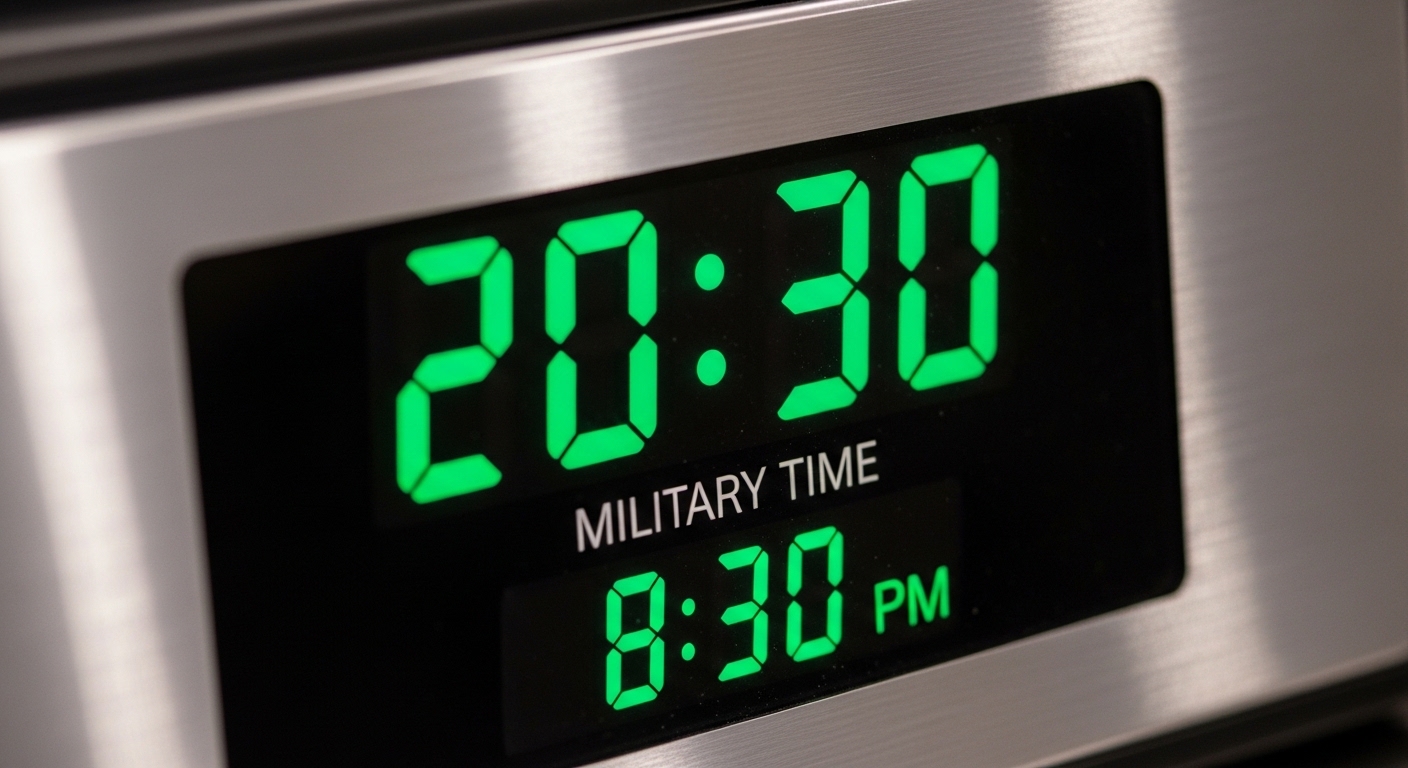
There’s something oddly cinematic about seeing 20:30 glowing on a screen. Maybe it’s the sharpness of it. Maybe it feels like the kind of timestamp attached to a pilot’s radio call, a late train in the rain, or a doctor scribbling notes while coffee goes cold beside a monitor. Either way, people stare at it for half a sec and go, “Wait… what time actually is that?”
And honestly, thats fair.
The world grew up mostly around the soft familiarity of the 12-Hour Clock, where mornings and evenings politely wear little AM and PM tags like nametags at a reunion. But then there’s the cleaner, stricter cousin the 24-Hour Clock a system that doesn’t bother with tiny suffixes because it expects you to know what’s going on already.
So, let’s settle it simply before we spiral into train schedules and hospital charts.
20:30 Military Time = 8:30 PM in standard time.
That’s it. That’s the answer. But also… weirdly not the whole answer.
Because understanding 20:30 Military Time opens a door into how humans built systems for precision, global coordination, and avoiding the absolute chaos of someone showing up twelve hours late because they thought 8 meant morning. Which, yes, happens more than people admit.
What Is 20:30 Military Time Exactly?
In the Military Clock Format, time runs from 00:00 all the way to 23:59 without restarting after noon. The day doesn’t split itself into AM and PM. It just keeps marching forward like a very organized duck.
So:
- 00:00 = Midnight
- 08:30 = 8:30 AM
- 13:00 = 1:00 PM
- 18:00 = 6:00 PM
- 20:30 = 8:30 PM
- 23:59 = 11:59 PM
- 24:00 sometimes represents the end of a day
When people ask “what is 20:30 military time”, they’re really asking how to perform a quick Time Format Conversion between the 24-hour time format and regular conversational time.
The trick is wonderfully simple:
- If the hour is greater than 12, subtract 12.
- Keep the minutes the same.
- Add PM.
So:
20 – 12 = 8
Therefore:
20:30 = 8:30 PM
Tiny math. Huge confidence boost.
Why Military Time Exists in the First Place
Imagine an exhausted nurse in a busy emergency room hearing “The patient arrives at 8.”
Which 8?
Morning? Evening? Yesterday’s regret?
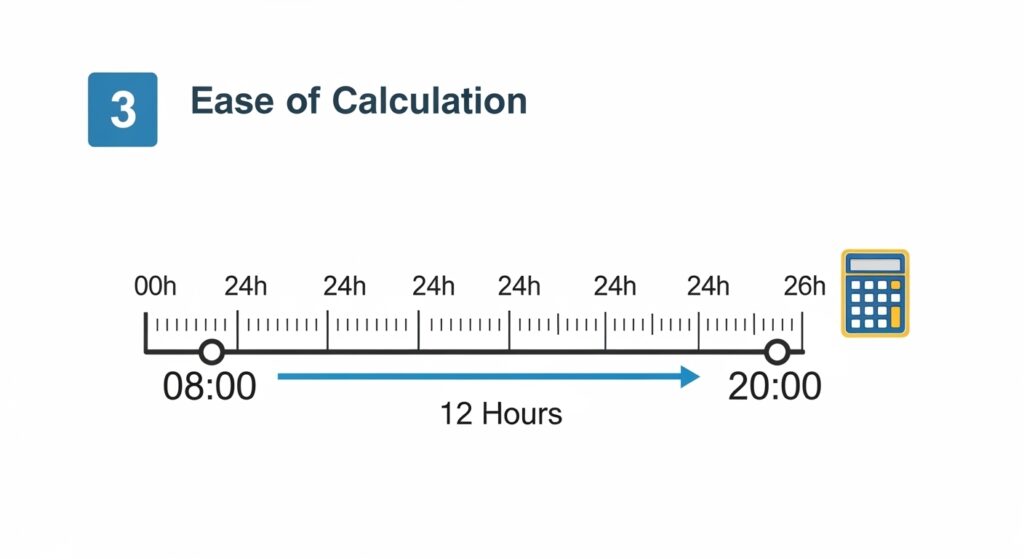
That confusion can become dangerous fast. That’s why industries that depend on Scheduling Accuracy use a standardized time format instead of relying on AM and PM.
Fields that commonly use Military Time include:
- Healthcare
- Emergency Services
- Hospitals
- Aviation
- Railways
- International Businesses
- The actual Military
In these places, Professional Time Communication matters more than convenience.
A pilot cannot casually wonder whether the runway slot was morning or evening. A surgeon can’t shrug at medication timing. Precision matters because humans are very, very talented at misunderstanding each other.
That’s one reason the Time Representation System of military time became globally respected. It creates Communication Clarity in situations where confusion could cost money, safety, or lives.
How to Convert 20:30 Military Time Without Confusion
A lot of people overcomplicate this. They start imagining secret military formulas or hidden clock lore passed down by stern captains. Nah. It’s easier than ordering fries.
Here’s the basic Time conversion formula:
For hours greater than 12:
Subtract 12 and add PM.
So:
- 13:00 → 1:00 PM
- 15:00 → 3:00 PM
- 1500 military time → 3 PM
- 18:00 → 6 PM
- 6 PM in military time → 18:00
- 20:30 → 8:30 PM
This is called the Hours greater than 12 rule, and once your brain sees the pattern, you stop needing charts.
It becomes almost automatic. Like tying shoes. Or accidentally opening the fridge and forgetting why you walked there.
Does 20:30 Mean PM?
Yep. Absolutely.
People often search:
- does 20:30 mean PM
- is 20:30 AM or PM
- 20:30 equals what time
The answer is always evening.
Anything from 13:00 to 23:59 belongs to PM hours in the regular clock system.
That’s part of the broader idea called PM range recognition, which sounds technical but really just means knowing afternoon and evening times when you see them.
A neat way to think about it:
- 01:00–11:59 → Morning hours
- 12:00 → Noon
- 13:00–23:59 → Afternoon and evening
So 20:30 sits comfortably in nighttime territory. Dinner-time. Movie-time. “I should probably answer those emails tomorrow” time.
Understanding the 24-Hour Clock Like a Human, Not a Robot
Some tutorials explain military time like they’re teaching astronauts to land on Jupiter. Relax a little, y’know.
The 24-Hour Clock is basically just counting the day honestly.
Instead of pretending 1 PM is another “1,” the clock says:
“Nope. We already had a 1 today. This is 13 now.”
That’s all.
It’s less confusing because numbers only appear once per day.
This creates stronger time synchronization for travel, scheduling, medicine, logistics, and global communication.
Here’s a simple mini-chart:
- 00:00 Midnight
- 01:00 1 AM
- 06:00 6 AM
- 12:00 Noon
- 13:00 1 PM
- 17:00 5 PM
- 20:30 8:30 PM
- 23:59 One minute before midnight
The consistency is kinda beautiful honestly. Like neat rows in a garden.
What Is 20:30 Military Time in Standard Time?
Let’s answer the headline directly again because people often skim articles while eating chips.
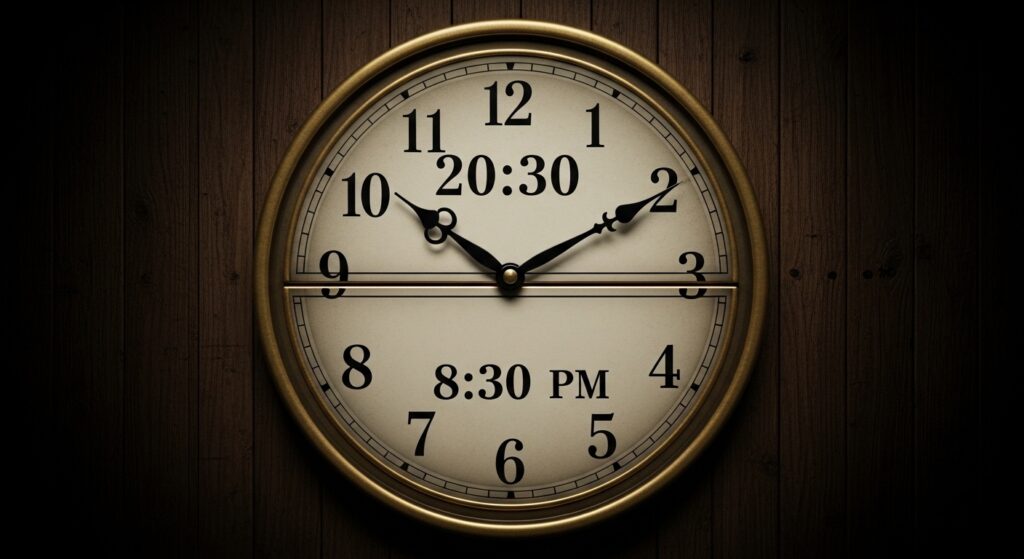
20:30 in standard time = 8:30 PM
Or written differently:
- 20:30 Military Time
- 2030 military time
- 8:30 PM military time
- 20:30 in standard time
All point toward the same evening hour.
This is one of the most common examples used in military time explained simply guides because it demonstrates the PM conversion rule perfectly.
And once you understand 20:30, suddenly other times become easy too.
The Difference Between Military Time and Regular Time
The biggest difference between military and regular time is notation.
The 12-Hour Clock repeats numbers twice daily:
- 1 AM and 1 PM
- 8 AM and 8 PM
The 24-hour clock conversion system removes repetition entirely.
That means:
- fewer mistakes
- stronger professional scheduling
- easier international coordination
- clearer digital systems
Which is why computers, airlines, and train stations adore it.
Imagine a railway announcement saying:
“Departure at 08:00.”
Nobody asks whether the train leaves tonight. That ambiguity disappears.
This idea of avoiding time confusion is one of the strongest arguments for military time worldwide.
How Military Time Works in Real Life
Funny thing is, many people already use military time without realizing it.
Your phone settings.
Airline tickets.
Hospital paperwork.
Train schedules.
Package tracking.
The modern world quietly runs on the global time system of 24-hour notation behind the scenes.
A doctor in a hospital might say:
“Medication administered at 20:30.”
A pilot might report:
“Landing scheduled for 2030 hours.”
An emergency responder could note:
“Incident received at 18:42.”
The point isn’t sounding intense. It’s ensuring precise scheduling and reducing misunderstanding.
As educator Marvi M. Andres once noted in a teaching discussion about clock literacy, students often learn faster when they recognize military time as “just a day counted straight through instead of split apart.” That phrasing kinda sticks with you.
A Quick Military Time Conversion Cheat Sheet
Here’s a practical little guide because brains enjoy shortcuts.
Morning Times
- 01:00 = 1 AM
- 05:00 = 5 AM
- 08:30 = 8:30 AM
- 11:00 = 11 AM
Afternoon & Evening Times
- 12:00 = Noon
- 13:00 = 1 PM
- 15:00 = 3 PM
- 18:00 = 6 PM
- 20:30 = 8:30 PM
- 23:59 = 11:59 PM
Special Cases
- 00:00 = Midnight
- 24:00 = End of the day
This kind of military time chart helps beginners recognize patterns quickly.
Why Students and Kids Learn Military Time Faster Than Adults Sometimes
Kids don’t carry years of “normal clock” habits, so they often adapt surprisingly fast.
Adults go:
“Wait, subtract what now?”
Meanwhile a ten-year-old casually says:
“20:30 means 8:30 PM because 20 minus 12 equals 8.”
Done. Finished. Juicebox break.
That’s why many educational platforms like Brighterly use structured learning and visual patterns to teach understanding 24-hour time.
Teachers such as Maila Caliao and Franz Jerby Delos Santos have emphasized how recognizing numerical patterns makes the system less intimidating for students.
And honestly, they’re right.
Military time isn’t hard. It’s just unfamiliar until suddenly it isn’t.
Common Mistakes People Make With 20:30 Military Time
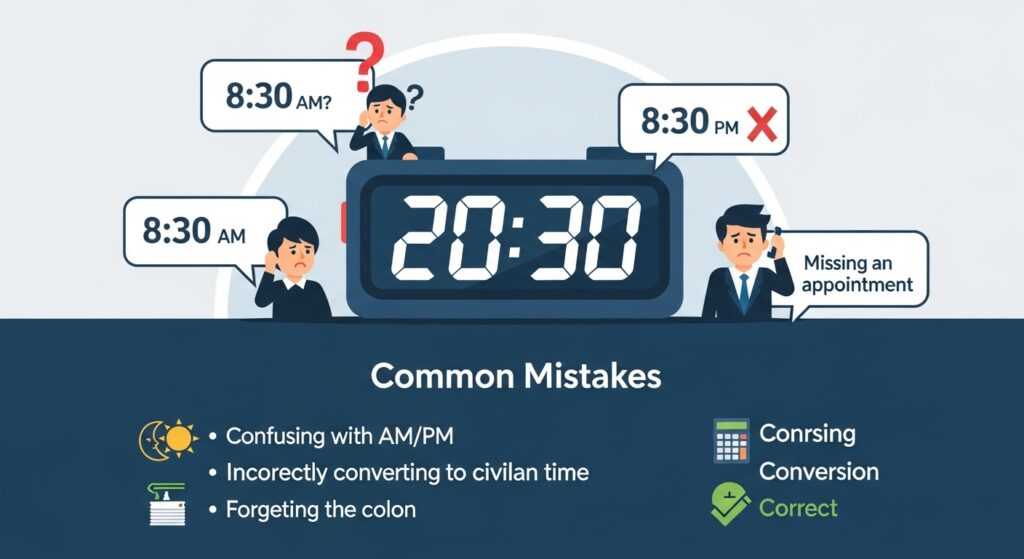
People tend to stumble in very predictable ways.
Mixing Up AM and PM
Someone sees 20:30 and thinks:
“20… must be morning?”
Nope. Anything above 12 belongs to PM territory.
Forgetting the Subtract 12 Rule
This is the classic one.
20:30
20 – 12 = 8
Therefore:
8:30 PM
Easy.
Confusing Midnight
A lot of folks wrestle with:
- 00:00
- 24:00
- Midnight
Understandably so. Midnight behaves like a cat. Technically there, emotionally confusing.
Why Aviation and Healthcare Depend on Military Time
This part matters more than people realize.
In Aviation, a missed or misunderstood time can disrupt flights across continents. Pilots, dispatchers, and Airlines use military notation because it supports global scheduling and eliminates ambiguity.
In Healthcare, especially inside Hospitals, medical staff record exact treatment times constantly. Medication intervals, surgeries, emergency admissions — all require clean documentation.
A doctor saying:
“Administered at 8”
…would be wildly irresponsible.
But:
“Administered at 20:30”
That’s precise.
That’s accountable.
That’s safe.
The same applies to Emergency Responders, railway operators, military personnel, and international logistics teams.
Military Time for Beginners: A Simple Memory Trick
Here’s the easiest shortcut ever.
Think of military time as:
“PM hours plus 12.”
So:
- 1 PM → 13:00
- 2 PM → 14:00
- 6 PM → 18:00
- 8:30 PM → 20:30
That’s it.
Once you see enough examples, your brain starts translating automatically.
You’ll glance at 21:15 and instantly know it’s 9:15 PM without even thinking much. Kinda like reading subtitles after a while.
How to Read Military Time Out Loud
Another thing people ask:
“How do you actually say it?”
There are two common ways.
Informal Style
- 20:30 = “eight-thirty PM”
Formal Military Style
- 2030 = “twenty thirty hours”
Both are acceptable depending on context.
Military personnel often pronounce leading zeros too:
- 08:00 → “zero eight hundred”
Which sounds dramatic enough to make ordering pizza feel tactical.
Military Time Explained Simply for Everyday People
If all this still feels complicated, here’s the gentlest explanation possible.
Military time is just a clock that:
- counts from 0 to 23
- never uses AM or PM
- avoids confusion
That’s genuinely it.
And:
20:30 = 8:30 PM
No hidden tricks. No elite math club. No secret decoder ring.
Just a cleaner way to write evening time.
How to Make Learning Military Time Easier
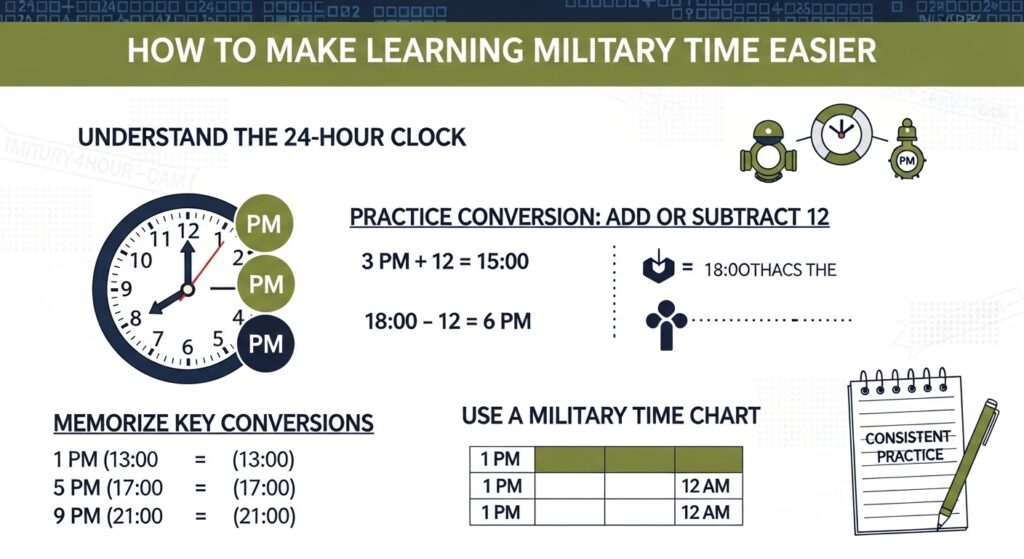
A few practical tips help alot.
Practice With Your Phone
Switch your phone temporarily to the 24-hour time format. Within days your brain adapts naturally.
Memorize Anchor Times
Learn a few key references:
- 12:00 = Noon
- 15:00 = 3 PM
- 18:00 = 6 PM
- 20:30 = 8:30 PM
Everything else branches from there.
Use Visual Charts
A simple military time table beside your desk can help reinforce the patterns.
Think in Blocks
- 00–11 = morning
- 12 = noon
- 13–23 = afternoon/evening
Easy enough.
The Quiet Beauty of Precise Time
Maybe that sounds dramatic for a clock article, but there’s something deeply human about trying to organize time carefully.
We build systems because life is busy and fragile and shared.
A surgeon preparing for an operation.
A train conductor coordinating arrivals.
A parent waiting at an airport.
A soldier following schedules.
A student learning their first clock notation system.
All of them rely on the same thing:
clear understanding.
That’s what Military Time really offers. Not toughness. Not mystery. Just clarity.
And in a world already noisy enough, clarity’s kinda precious.
Frequently asked Questions
20:30 military time
20:30 military time means 8:30 PM in standard 12-hour clock format. In the 24-hour system, any hour above 12 represents evening or nighttime hours.
2030 military time
2030 military time is another way of writing 20:30, which converts to 8:30 PM. It is commonly used in military, healthcare, and aviation schedules for clear communication.
what time is 2030
2030 in military time equals 8:30 PM in regular time format. You simply subtract 12 from 20 to get the standard evening hour.
20:30 military
20:30 military refers to the 24-hour clock notation for 8:30 PM. This format removes AM and PM confusion and is widely used around the world.
Read this Blog: https://maxenkad.com/long-is-9-inches/
Final Thoughts on What 20:30 Military Time Means
So, one last time for the skimmers in the back:
20:30 military time = 8:30 PM standard time.
It belongs to the evening portion of the day and follows the straightforward logic of the 24-Hour Clock system.
Once you understand the:
- subtract 12 rule
- PM range
- basic time calculation method
…the entire system starts feeling surprisingly intuitive.
Whether you’re learning for school, travel, healthcare work, aviation, emergency response, or simple curiosity, understanding military time gives you a sharper sense of professional time communication and modern scheduling systems.
And honestly? After a while, regular clocks start looking slightly less efficient. Just a tiny bit.
If you’ve got a favorite memory involving military time confusion, airport schedules, or learning the 24-hour system for the first time, share it with others. Those tiny stories make learning feel human instead of mechanical.
Timekeeping isn’t only numbers on a screen. It’s people trying to meet each other accurately in the middle of life.