

There’s a weird little sound a card makes when you slide it from a fresh booster pack for the very first time. Not loud. More like a papery whisper mixed with tiny static electricity. Anyone who’s ever opened a pack of Pokémon cards at a kitchen table knows it.
Maybe it was a shiny Charizard, maybe just another Energy card you already owned 14 times, but still your fingers paused for half a second because these cards somehow feel bigger than cardboard. Funny thing is, they’re actually measured down to the millimeter with almost absurd precision.
And honestly? Most people don’t realize how much the exact size of a Pokémon card matters until they buy sleeves that don’t fit, discover a suspiciously thick holo, or accidentally bend a favorite Mewtwo while stuffing it into a binder pocket too small.
I seen a kid once try to cram a jumbo promo into a regular binder sleeve and the poor thing looked like a folded pizza menu afterward. Brutal.
The world of the Pokémon Trading Card Game (TCG) runs on consistency. Competitive play, grading, shuffling, storage, collecting, shipping all of it leans heavily on exact measurements and manufacturing standards.
Even the tiniest variance can become a clue for spotting Counterfeit Pokémon cards. Which is kinda wild if you think about it. A fraction of a millimeter deciding whether a card is legit or fake? Tiny cardboard detectives everywhere.
So this guide dives deep into Pokémon card dimensions, measurements, thickness, protection, sleeve sizing, storage systems, grading standards, counterfeit detection, and all the odd little details collectors obsess over at 1:13 AM while reorganizing binders for no reason at all.
| Specification | Standard Measurement / Fact |
|---|---|
| Standard Pokémon card dimensions | 2.5 in × 3.5 in |
| Metric size | 63.5 mm × 88.9 mm |
| Pokémon aspect ratio | 5:7 |
| Average card thickness | 0.012 in / 0.305 mm |
| Average card weight | 1.78 g |
| Standard sleeve size | 67 × 91 mm |
| Toploader size | 76 × 101 mm |
| Jumbo Pokémon card size | 5 in × 7 in |
| Card corner style | Rounded card corners |
| Main card material | Multi-layer cardstock with foil layering |
| Tournament legal size | Must match official Pokémon card measurements |
| Best sleeve brands | Dragon Shield, Ultra Pro Eclipse |
| Basic protection | Penny sleeves + Toploaders |
| Best storage options | Binder pockets, Deck boxes, Elite Trainer Box (ETB) |
| Safe storage materials | Acid-free & PVC-free pockets |
| Used in gameplay | Basic Pokémon cards, Trainer cards, Energy cards, Supporter cards |
| Popular grading companies | PSA and Beckett |
| Counterfeit detection clues | Wrong thickness, weight, gloss, or dimensions |
| Compared with Yu-Gi-Oh! | Pokémon cards are slightly larger |
| Compared with Magic: The Gathering | Nearly same standard trading card size |
| Long-term storage tip | Keep cards away from heat, humidity, and sunlight |
The Standard Pokémon Card Dimensions Everyone Should Know
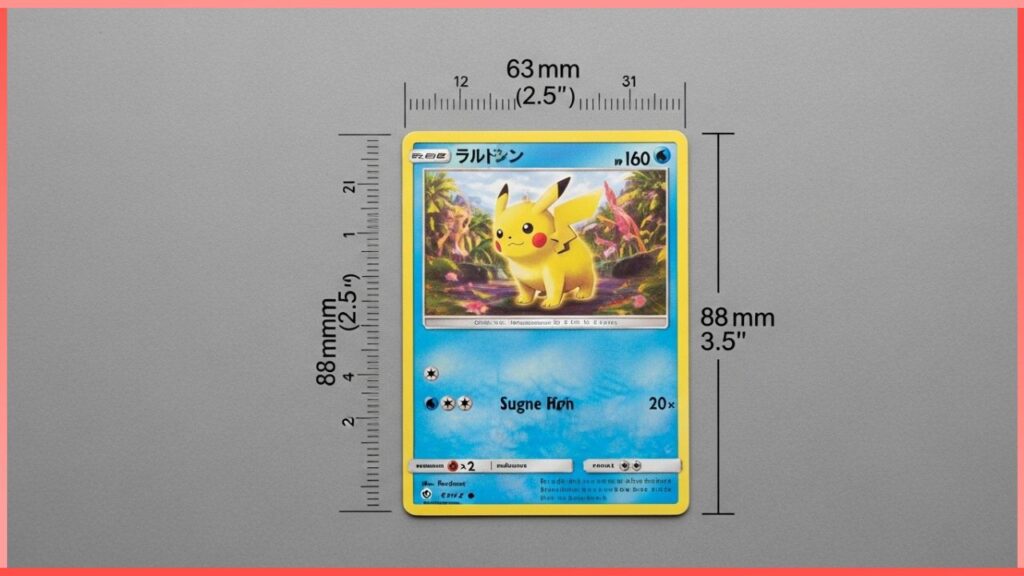
The official standard Pokémon card dimensions are:
- 2.5 in × 3.5 in
- 63.5 mm × 88.9 mm
- Roughly a 5:7 aspect ratio
That size has become the benchmark for many modern collectible card games, not just Pokémon. It’s considered the standard trading card size, shared closely with games like Magic: The Gathering and even parts of KeyForge design philosophy. Though some games tweak edges and cardstock slightly, Pokémon cards stay remarkably consistant over the years.
Here’s the thing people forget: dimensions aren’t just for aesthetics. The exact Pokémon card width and Pokémon card height are engineered for practical reasons:
- Comfortable shuffling
- Stack stability
- Tournament fairness
- Printing consistency
- Sleeve compatibility
- Binder uniformity
If cards varied too much, competitive play would become chaos real quick. Imagine trying to shuffle a deck where one card is slightly taller than the rest. Players would identify key cards by touch alone. Thats a nightmare in tournament settings.
The official Pokémon card measurements in mm matter especially for:
- Basic Pokémon cards
- Evolution Pokémon cards
- Trainer cards
- Supporter cards
- Stadium cards
- Energy cards
Every legal card follows the same foundational sizing rules.
Pokémon Card Thickness, Weight, and Cardstock Facts
Now this is where collectors become accidental scientists.
The average Pokémon card thickness is approximately:
- 0.012 in thickness
- 0.305 mm thickness
And the average Pokémon card weight usually lands around:
- 1.78 g card weight
Tiny numbers, huge implications.
A genuine Pokémon card has carefully layered cardstock. The inner core, print coating, foil layering, and protective finish all contribute to specific texture and flex.
Authentic cards bend in a very particular way. Counterfeits often feel too glossy, too stiff, or weirdly flimsy like cheap cereal-box cardboard pretending to have confidence.
When people discuss Pokémon card material, they’re usually talking about:
- Cardstock composition
- Surface finish
- Foil layering
- Print density
- Edge compression
A real holo Blastoise often has a clean layered shine that reflects light smoothly, while fake cards can look almost oily under bright light. Hard to explain unless you’ve held both side-by-side. One feels like a trading card. The other feels like it owes you money.
Collectors doing dimensional analysis for authenticity often check:
- Thickness consistency
- Edge cuts
- Weight verification
- Corner shape
- Surface texture
That’s become increasingly important because modern fake Pokémon cards are honestly getting scarily convincing.
Pokémon Card Dimensions Compared to Other TCG Games
The funny thing is, if you lay cards from different games side by side, they look almost identical until you become weirdly obsessive about corners and cardstock.
Here’s how Pokémon compares:
| Game | Dimensions |
|---|---|
| Pokémon Trading Card Game (TCG) | 63.5 mm × 88.9 mm |
| Magic: The Gathering | 63 × 88 mm |
| Yu-Gi-Oh! | 59 × 86 mm |
| KeyForge | Standard-sized variations |
The smaller size of Yu-Gi-Oh! cards especially catches people off guard. You can’t safely use Pokémon sleeves on them without awkward movement inside the sleeve. It rattles around kinda sadly.
Meanwhile Pokémon and Magic: The Gathering are close enough that some accessories overlap, though serious collectors usually buy game-specific protection anyway.
That tiny dimensional consistency across games created a massive ecosystem of:
- Sleeves
- Binder pages
- Storage boxes
- Grading cases
- Display stands
Which honestly explains why the hobby exploded so much globally. Infrastructure matters more than people think.
Pokémon Card Sleeves and Protection Sizes
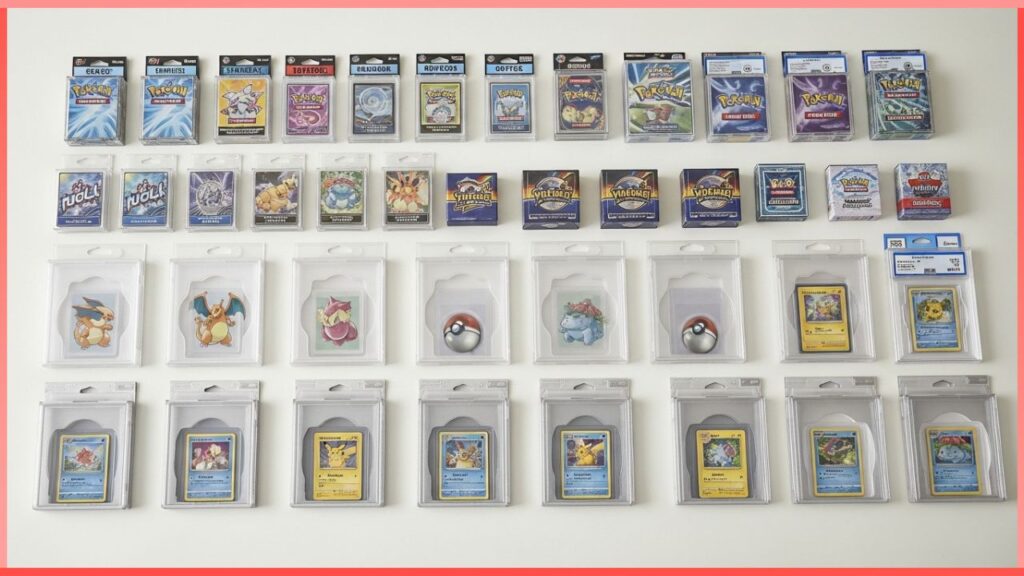
If you own valuable cards, protection stops being optional very quickly.
The standard Pokémon card sleeve size is:
- 67 × 91 mm sleeve size
That little extra room allows smooth insertion without damaging corners. Tight sleeves might look cleaner but can nick edges over time, especially with holo cards.
Popular sleeve brands include:
- Dragon Shield
- Ultra Pro Eclipse
- Generic Penny sleeves
And yes, there’s a huge difference.
Premium sleeves like Dragon Shield are thicker and designed for repeated shuffling during tournaments. They’re fantastic for card shuffling durability, though some players dislike the slightly textured feel.
Meanwhile penny sleeves are thinner and cheaper, mostly intended for storage rather than gameplay. They crinkle easier but remain popular because they’re affordable for massive collections.
People protecting expensive pulls often use layered protection:
- Penny sleeve
- Toploader
- Team bag
- Storage box
Which sounds dramatic until you remember some cards are worth thousands.
A holographic Charizard from older sets can legit feel like holding a tiny retirement account.
Pokémon Card Protection Guide for Serious Collectors
Proper Pokémon card protection isn’t just about avoiding scratches. It’s about preserving long-term collector value.
The biggest enemies of cards are:
- Humidity
- Sunlight
- Heat
- Dust
- Oils from fingers
- Edge pressure
I once saw somebody store rare holos loose in a shoebox near a window. Sun damage turned the backs pale blue-ish. Hurt my soul a little bit honestly.
For effective collection preservation, collectors use:
- Acid-free storage
- PVC-free pockets
- Rigid card protection
- Climate-safe containers
The recommended toploader size for standard Pokémon cards is:
- 76 × 101 mm toploader size
Toploaders add rigidity that sleeves alone can’t provide. They’re especially useful for shipping cards or protecting high-end graded candidates.
Some advanced collectors even monitor room humidity levels for archival card storage. Sounds excessive until you realize vintage collections can rival the price of cars.
Binder Pockets, Deck Boxes, and Storage Dimensions
Good storage feels oddly satisfying. Like alphabetizing books or perfectly stacking pancakes.
For regular collections, most people use:
- Binder pockets
- Deck boxes
- Elite Trainer Box (ETB) storage
- Bulk card containers
The best binders use:
- Side-loading pockets
- Acid-free pages
- Reinforced seams
- Zipper closure
Cheap binders with metal rings can damage cards over time due to pressure points. Ring dents are basically collector heartbreak compressed into a line shape.
Typical deck box dimensions are optimized for sleeved cards, especially during Pokémon deck construction. Competitive players often calculate:
- Sleeved deck thickness
- Sideboard room
- Dice storage
- Token space
A standard tournament deck usually contains 60 cards, though sleeve thickness can dramatically affect fit.
Some products designed specifically for storage include:
- Theme Deck boxes
- Battle Deck containers
- ETB organizers
The inside dimensions of an Elite Trainer Box (ETB) are surprisingly useful for long-term sorting too. People use them for bulk commons, reverse holos, and energy stacks all the time.
Jumbo Pokémon Card Dimensions Explained
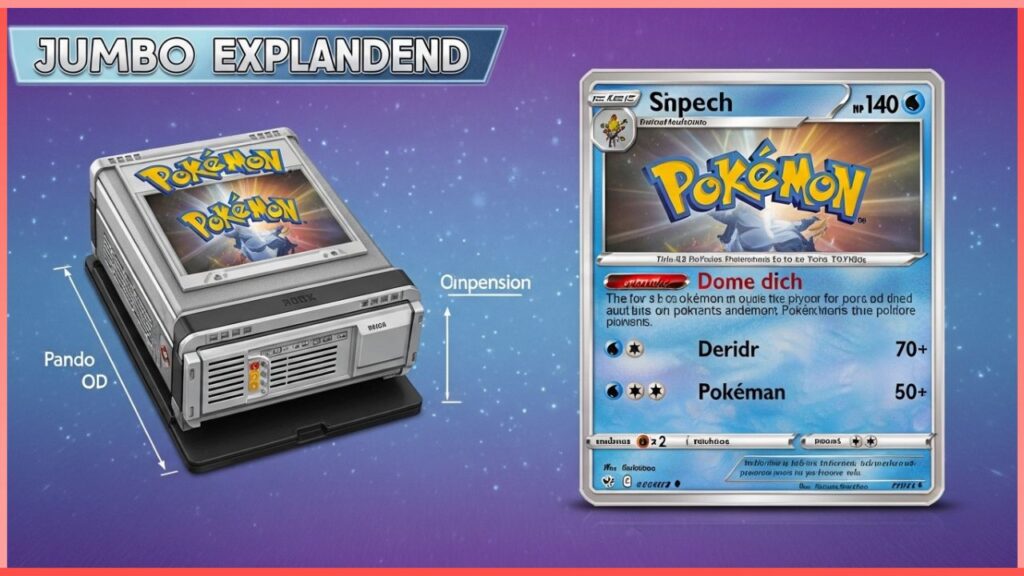
Now we enter giant cardboard territory.
Jumbo Pokémon card dimensions commonly measure around:
- 5 in × 7 in oversized card size
These oversized Pokémon cards aren’t tournament legal but are wildly popular for display purposes. They’re usually included in special collection boxes and promotional products.
The challenge is protection.
Standard sleeves obviously don’t fit them, which leads collectors into strange DIY solutions involving scrapbook pages and oversized photo protectors. Kinda charming honestly.
Dedicated jumbo binders exist now, thankfully. Older collectors had to improvise in deeply questionable ways.
Pokémon Card Dimensions and Tournament Legality
Competitive play depends heavily on trading card consistency.
Tournament officials check cards for:
- Excessive bending
- Marked edges
- Size irregularities
- Sleeve consistency
- Damage visibility
Even slightly warped cards can become problematic because players might identify them while shuffling.
That’s why tournament legal cards must maintain:
- Uniform dimensions
- Consistent sleeve opacity
- Comparable wear patterns
In high-level events, deck presentation matters almost as much as strategy. A marked card can trigger penalties even if accidental.
Professional players often use:
- Matching sleeves
- Fresh deck boxes
- Clean binder organization
- Consistent handling techniques
Because prevention is easier than explaining suspicious wear to a judge at round five while sweating through your hoodie.
Fake Pokémon Cards and Dimensional Clues
Counterfeit detection has become a genuine skill within the hobby.
Many fake cards fail basic Pokémon card measurements tests because counterfeit manufacturers struggle maintaining exact tolerances.
Warning signs include:
- Incorrect thickness
- Unusual weight
- Glossy finish
- Oversized borders
- Bad corner cuts
- Strange fonts
Real cards maintain strict card tolerances during production.
Collectors often compare suspicious cards beside authentic ones under bright light. Some even perform a gentle thickness test by stacking cards and comparing edge height.
For serious verification, grading companies like PSA and Beckett evaluate:
- Print alignment
- Surface texture
- Edge cuts
- Cardstock quality
- Dimensional precision
That level of card authentication has become increasingly valuable as counterfeit operations improve.
A collector once described spotting fake cards as “feeling a tiny lie with your fingertips,” which honestly sounds poetic enough to belong in a museum.
Japanese Pokémon Cards vs English Pokémon Cards
There are subtle differences between Japanese Pokémon cards and English Pokémon cards, though dimensions stay mostly standardized.
Japanese cards often feature:
- Different cardstock texture
- Sharper print quality
- Distinct gloss finishes
- Slightly firmer feel
Collectors sometimes claim Japanese cards age better over time. Whether that’s scientifically true or just collector folklore… eh, debate continues.
Still, both maintain the same essential Pokémon aspect ratio and overall card specifications, ensuring compatibility with sleeves and accessories.
Card Grading Standards and Investment Value
Once cards enter grading slabs, dimensions become even more critical.
Companies like PSA and Beckett assess:
- Centering
- Surface wear
- Edge quality
- Corner sharpness
- Printing consistency
Tiny measurement deviations can affect grades dramatically.
A card graded PSA 10 versus PSA 9 might differ by almost invisible flaws. Yet the market value difference can become absolutely bananas.
Collectors pursuing investment-grade Pokémon cards prioritize:
- Mint condition
- Proper storage
- Minimal handling
- High-quality protection
That’s why holographic card protection became such a massive industry. Even microscopic scratches matter.
And honestly? There’s something kinda beautiful about people treating childhood nostalgia with museum-level care.
How to Store Pokémon Cards Long-Term
If you’re serious about Pokémon card storage, here’s the practical setup many experienced collectors recommend:
- Sleeve every holo immediately
- Use toploaders for valuable cards
- Store binders upright
- Avoid humid rooms
- Keep away from sunlight
- Use archival-safe materials only
For bulk collections:
- Sort by set
- Label storage boxes
- Avoid overstuffing
- Use dividers
Temperature swings are sneaky dangerous too. Heat can warp cards gradually over years.
One collector from Osaka reportedly kept rare cards inside humidity-controlled cabinets normally intended for photography equipment. Sounds excessive until you see vintage card prices lately.
Frequently asked Questions
pokemon card dimensions
Standard Pokémon card dimensions are 2.5 × 3.5 inches, making them the same size as most traditional trading cards. These measurements are carefully standardized for gameplay, storage, and protective accessories.
pokemon card size
The official Pokémon card size is 63.5 × 88.9 mm (2.5 × 3.5 inches). This universal sizing allows cards to fit perfectly in sleeves, binders, and deck boxes designed for trading card games.
pokemon card aspect ratio
Pokémon cards follow a 5:7 aspect ratio, which gives them their balanced rectangular shape. This ratio has become a long-standing standard across many collectible card games.
what are the dimensions of pokemon cards
The exact dimensions of Pokémon cards are 2.5 inches wide by 3.5 inches tall, or 63.5 mm × 88.9 mm. Their thickness is approximately 0.012 inches (0.305 mm).
pokemon card dimensions mm
In millimeters, Pokémon card dimensions measure 63.5 mm in width and 88.9 mm in height. These precise measurements ensure consistency across all official Pokémon TCG cards.
Read this Blog: https://maxenkad.com/how-is-long-1-foot/
Why Pokémon Card Dimensions Matter More Than You Think
At first glance, measuring cardboard rectangles feels deeply nerdy. Because it is. But it’s also practical, historical, competitive, and strangely emotional.
The exact Pokémon card size affects:
- Gameplay fairness
- Collector value
- Authentication
- Storage compatibility
- Protection quality
- Long-term preservation
Without standardized sizing, the entire collectible card ecosystem would honestly collapse into chaos. Sleeves wouldn’t fit. Binders would fail. Grading slabs would vary wildly. Tournament decks would become impossible to regulate.
Tiny dimensions quietly hold the whole hobby together.
And there’s somthing oddly comforting in that consistency. Through changing generations, evolving artwork, rising prices, new mechanics, and endless waves of nostalgia, a Pokémon card still fits perfectly in your hand exactly the way it did decades ago.
Maybe thats why people keep collecting them. Not just because of rarity or value, but because every card carries a strangely durable little feeling of continuity.
So whether you’re protecting a childhood holo, organizing your first binder, chasing a graded Charizard, or teaching a younger cousin how to shuffle carefully without bending corners understanding Pokémon card dimensions helps you care for the hobby properly.
And if you’ve got your own storage tricks, grading stories, or favorite protection setup, honestly share em. Card collectors always have the best oddly-specific wisdom hiding somewhere.