

There’s something weirdly magical about holding a Pokémon card in your hand. Not just because it might be a shiny Charizard, or an old-school Mewtwo that smells faintly like childhood and carpet dust, but because these little rectangles carry stories.
Tiny cardboard universes, honestly. One card can remind someone of playground trades, binder flexes, or that painful moment when their cousin bent a holographic rare card like it was no big deal. Brutal, really.
If you collect, play, trade, grade, or just obsess over the Pokémon Trading Card Game, knowing exact Pokémon card dimensions matters way more than people think. It’s not just nerd trivia, nah.
It affects sleeves, storage, grading, deck building, authentication, and whether your prized holo survives the next decade without becoming a sad curled pancake.
And funny enough, card size tells stories too. It whispers manufacturing secrets. It exposes fakes. It determines tournament legality. It even influences shuffle feel, which sounds dramatic but is actualy true.
So yeah, this guide dives deep into everything you need to know about Pokémon card size, Pokémon card thickness, protection, storage, comparisons, and counterfeit detection. Think of this as your all-in-one card dimension handbook, minus the boring textbook vibes.
| Specification | Measurement |
|---|---|
| Standard Pokémon Card Size | 2.5 × 3.5 inches |
| Size in Millimeters | 63.5 × 88.9 mm |
| Card Thickness | 0.012 inches / 0.305 mm |
| Card Weight | ~1.78 g |
| Aspect Ratio | 5:7 |
| Corner Radius | 0.125 in / 3.18 mm |
| Sleeve Size | 66 × 91 mm or 67 × 92 mm |
| Toploader Size | 3 × 4 inches |
| Binder Pocket Size | Standard TCG Size |
| Jumbo Card Size | ~5.7 × 8 inches |
Pokémon Card Dimensions: The Exact Standard Size
Let’s begin with the thing everyone asks.
What are the exact Pokémon card dimensions?
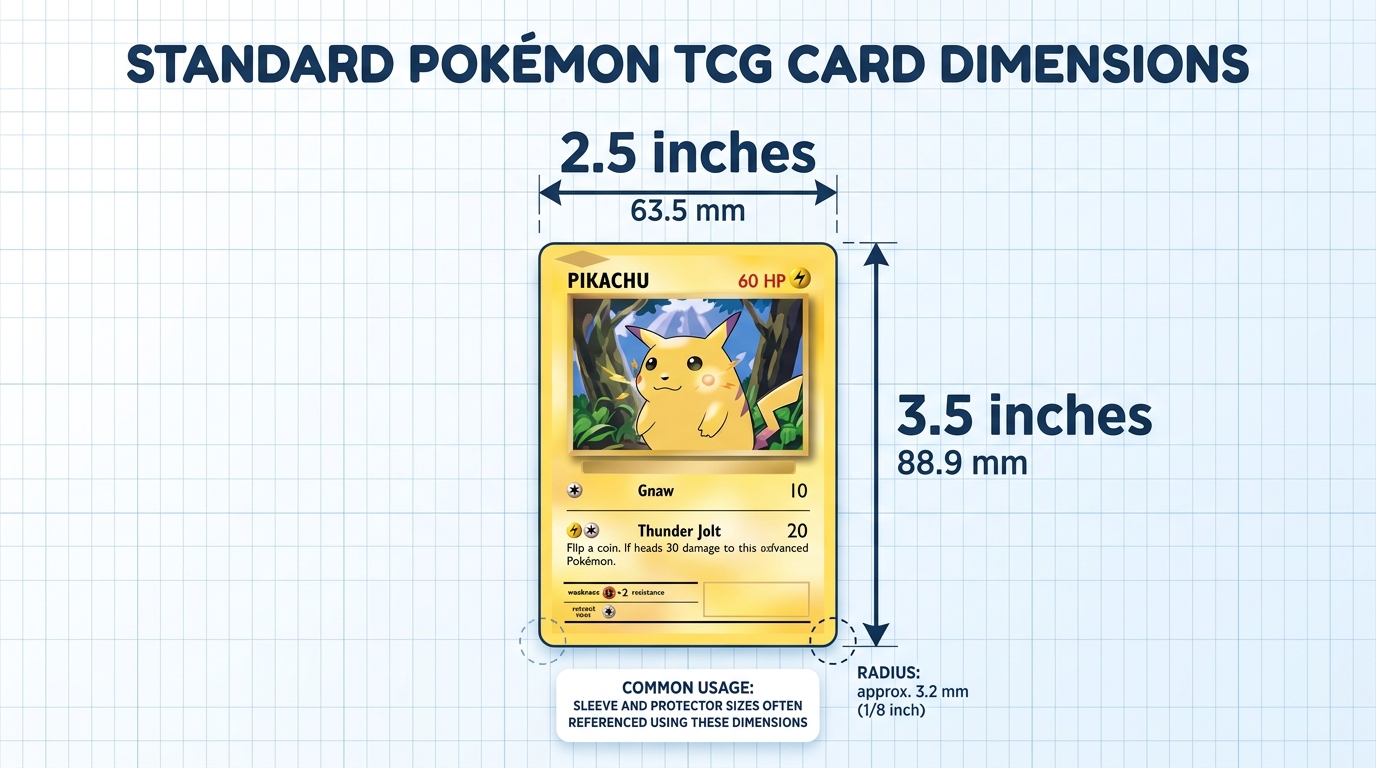
The standard size for official Pokémon cards is:
- 2.5 in × 3.5 in
- 63.5 mm × 88.9 mm
That’s the globally recognized Standard card size, used across modern Pokémon sets.
Important specifications include:
- Card width: 2.5 inches (63.5 mm)
- Card height: 3.5 inches (88.9 mm)
- Card thickness: 0.012 in thickness
- 0.305 mm thickness
- Card weight: approximately 1.78 g weight
- Aspect ratio: 5:7 aspect ratio
- Corner radius: 0.125 in corner radius
- 3.18 mm corner radius
Tiny measurements, huge impact.
The dimensions are carefully standardized for gameplay consistency, storage compatibility, and manufacturing precision. Even a small difference in thickness or edge rounding can make a card feel suspiciously wrong. Seasoned collectors can often detect fakes just by touch, which sounds wizard-ish but happens all the time.
That’s where Dimensional tolerance enters. Real cards allow only very tiny variations due to Measurement standards in manufacturing.
A legitimate Pokémon card usually feels exact. Fakes? They’re often slightly too thick, too thin, or weirdly glossy.
And yes people notice.
Why Pokémon Card Dimensions Matter More Than You Think
At first glance, dimensions seem kinda boring. Numbers. Millimeters. Cardboard math.
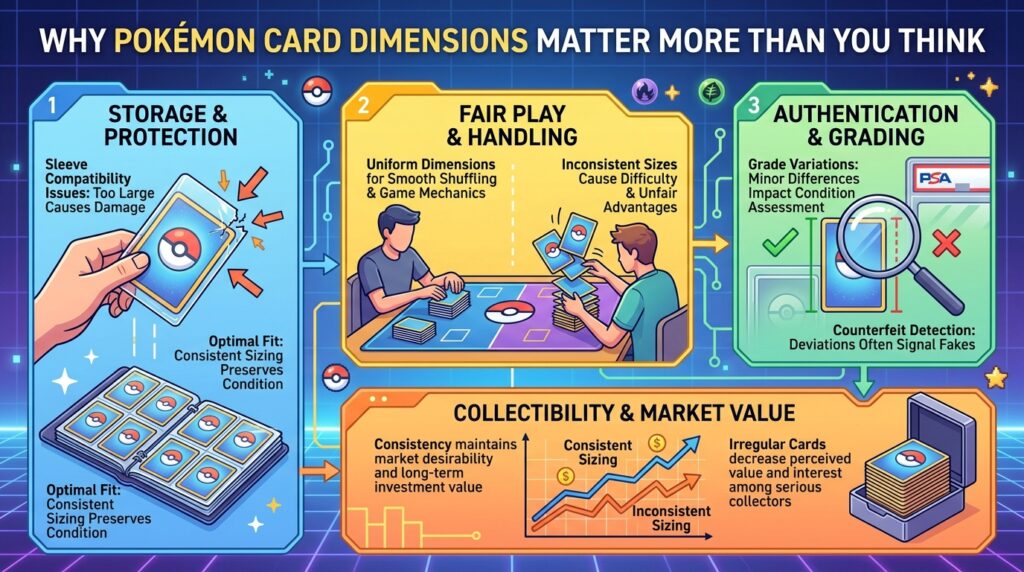
But dimensions matter for five major reasons:
- Gameplay
- Storage
- Protection
- Grading
- Counterfeit detection
In tournaments, cards need uniformity. A card that’s warped, oversized, or too thick may be considered marked. That can create unfair advantages during shuffling or deck cuts.
For collectors, dimensions determine:
- Which Penny sleeves fit
- Which Premium sleeves offer best protection
- Proper Toploaders
- Correct Binder pockets
- Compatible Deck boxes
- Safe Storage boxes
A card too tight in a sleeve? Corner damage risk.
Too loose? Movement causes scratches.
It’s honestly a little chaotic if you buy the wrong accessories.
Pokémon Card Dimensions and Card Construction
A Pokémon card isn’t just cardboard. Nope. It’s layered engineering disguised as nostalgia.
Official cards are made using:
- Cardstock
- Multi-layer paper construction
- Adhesive layers
- Ink layering
- Protective coating
- Sometimes Foil layering
- Lamination
That layered build gives cards their unique firmness and bend response.
High-quality manufacturing ensures:
- Durable edges
- Smooth corners
- Consistent weight
- Reliable thickness
- Long-term durability
This is why real cards feel distinct compared to cheap counterfeits.
Manufacturing consistency matters enormously in collectible trading cards. Even slight production changes are closely monitored by grading companies like PSA and Beckett.
A genuine holo card should feel premium not weirdly plastic or paper-thin.
Pokémon Card Thickness: How Thick Is a Pokémon Card?
One of the most searched questions is: how thick is a Pokémon card?
Standard answer:
- 0.012 inches
- 0.305 mm
That’s average for official modern cards.
Thickness can vary slightly depending on:
- Set
- Printing region
- Foil treatment
- Age
- Manufacturing run
For example, Holographic cards may feel slightly different due to foil treatments. Vintage cards from earlier eras can also vary a tiny bit.
Still, legit cards stay close to standard thickness.
When checking for Fake Pokémon cards, thickness is often one of the first things collectors inspect.
Too thick? Suspicious.
Too flimsy? Suspicious.
Feels weirdly glossy? Also suspicious.
Basically if your card feels like cereal box cardboard… yeah.
Pokémon Card Dimensions vs Other Trading Cards
How do Pokémon cards compare to other major TCGs?
Pokémon vs Magic Card Size
Both Pokémon and Magic: The Gathering use standard dimensions:
- 2.5 x 3.5 inches
- 63.5 x 88.9 mm
So in terms of physical dimensions, they’re basically identical.
This means many sleeves and storage products overlap.
Pokémon vs Yu-Gi-Oh Card Size
Here’s where things differ.
Yu-Gi-Oh! cards are smaller.
Typical Yu-Gi-Oh size:
- 59 mm × 86 mm
That makes them narrower and shorter.
So if you buy sleeves for Pokémon and try using them for Yu-Gi-Oh cards, they’ll feel loose.
It’s a common beginner mistake. Happens alot.
Pokémon Card Sleeve Size: What Sleeves Should You Use?
If you’re asking what size sleeves for Pokémon cards, here’s the answer.
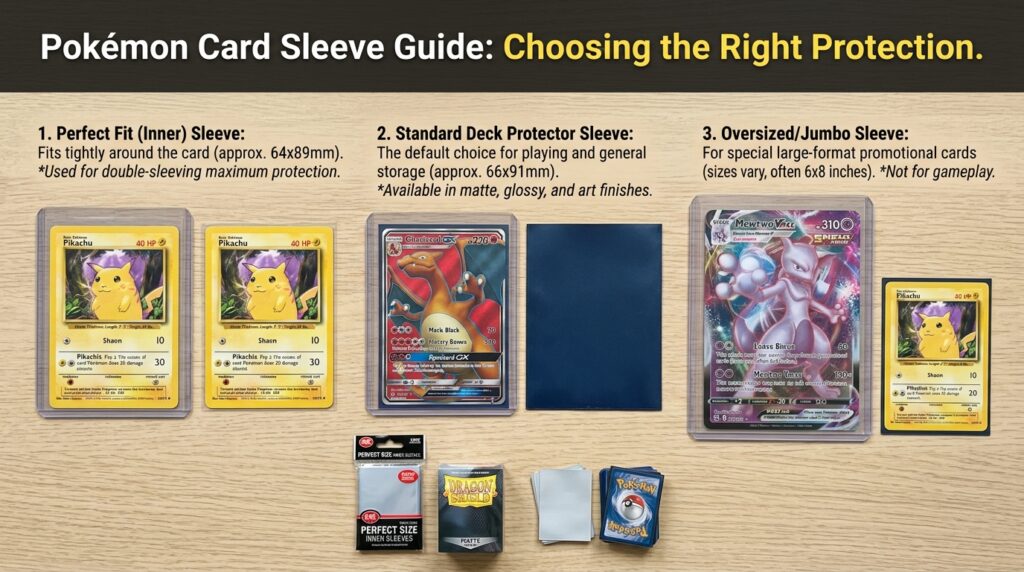
Because Pokémon uses standard TCG dimensions, standard sleeves fit best.
Common sleeve types include:
- Penny sleeves
- Premium sleeves
- Tournament sleeves
Popular brands include:
- Dragon Shield
- Ultra Pro
Recommended sleeve sizes:
- 66 x 91 mm
- 67 x 92 mm
Penny Sleeves
Cheap, basic protection.
Great for:
- Bulk storage
- Binder organization
- Quick protection
Pros:
- Affordable
- Lightweight
Cons:
- Thin
- Minimal structure
Premium Sleeves
Better for:
- Competitive decks
- Rare cards
- Valuable collections
Pros:
- Stronger material
- Better shuffle feel
- Improved durability
If you own rare Charizard, premium sleeves are worth it. No question.
Pokémon Toploader Size and Rigid Protection
For stronger protection, collectors use Toploaders.
These provide:
- Rigid protection
- Scratch protection
- Corner protection
- Dust protection
They’re essential for shipping or long-term storage of valuable cards.
Best for:
- Rare cards
- Graded candidates
- Vintage cards
- Investment pieces
Standard Pokémon toploader size is usually built for standard cards.
Collectors often double-protect cards:
- Sleeve first
- Toploader second
Simple. Effective. Kinda satisfying too.
Pokémon Binder Pocket Size and Storage Solutions
Storage matters more than people expect.
Good Pokémon card storage protects both value and condition.
Popular storage methods:
- Binders
- Storage boxes
- Toploader storage boxes
Look for:
- PVC-free pockets
- Acid-free pockets
Avoid cheap binders with low-quality plastic pages. They can damage surfaces over time. Slowly, sneaky-like.
Recommended storage capacities:
- 400-count box
- 800-count box
- 1600-count box
For serious collectors, organization becomes an art form.
Some sort by:
- Set
- Type
- Rarity
- Value
- Generation
Others organize by vibes. Which honestly, respect.
Oversized Pokémon Card Dimensions
Not all Pokémon cards follow standard dimensions.
Oversized Pokémon cards (jumbo cards) are much larger.
Common jumbo sizes include:
- Around 5.7 x 8 inches
- Older promos may vary
These include many:
- Promo cards
- Box exclusives
- Collector releases
Because sizes vary, jumbo cards require special storage solutions.
That’s why standard sleeves, binders, and toploaders won’t fit them.
If you collect jumbo cards, dedicated oversized storage is a must.
Pokémon Card Dimensions in Gameplay and Deck Building
Dimensions directly affect gameplay.
In a Tournament deck or Competitive deck, consistency matters.
A standard deck includes:
- Basic Pokémon cards
- Evolution cards
- Trainer cards
- Item cards
- Supporter cards
- Energy cards
- Special Energy cards
- Stadium cards
All need to shuffle uniformly.
Why?
Because inconsistent sizing creates marked cards.
This impacts:
- Deck construction
- Deck thickness
- Shuffle handling
- Tournament legality
- Gameplay dimensions
Even warped cards can create issues.
Serious players regularly replace worn sleeves to maintain consistency.
Pokémon Card Dimensions for Grading
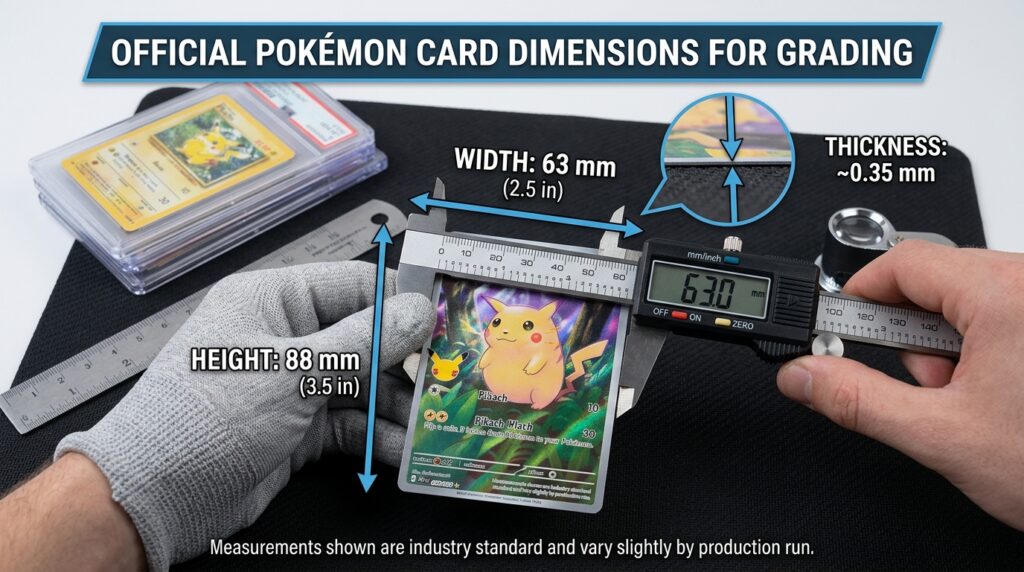
Grading companies like PSA and Beckett care deeply about dimensions.
They inspect:
- Centering
- Corners
- Surface
- Edges
- Authenticity
Dimension consistency supports grading confidence.
Cards that are off-size may be flagged.
This is huge in:
- Card collecting
- Rare cards
- Vintage cards
- Graded cards
- Investment cards
A PSA 10 can dramatically increase Collector value.
Sometimes by thousands.
Which feels wild untill you see auction numbers.
Pokémon Counterfeit Detection Using Dimensions
This is one of the most practical uses of measurements.
Counterfeit detection often starts with physical inspection.
Key checks:
- Dimensional analysis
- Thickness test
- Weight verification
- Corner radius analysis
How to spot fake cards:
- Measure width and height
- Check thickness
- Weigh the card
- Inspect corners
- Compare with authentic cards
Red flags include:
- Wrong dimensions
- Unusual gloss
- Poor print quality
- Off-center borders
- Weak cardstock
Real vs fake can be subtle.
But dimensions rarely lie.
That’s why Pokémon counterfeit detection relies heavily on measurements.
Pokémon Card Storage for Long-Term Preservation
Long-term storage is all about protection and environment.
For best results:
- Keep cards in sleeves
- Use rigid protection for valuables
- Store in cool dry areas
- Avoid direct sunlight
Ideal conditions include:
- Low humidity
- Stable temperature
- Clean storage space
Many collectors prefer:
- Climate-controlled storage
- Secure shelving
- Protected storage containers
This improves:
- Long-term preservation
- Surface protection
- Edge integrity
Your future self will thank you.
Especially if today’s binder card becomes tomorrow’s grail.
Rare Pokémon Cards and Investment Value

Some cards are collectibles.
Some are serious assets.
High-value categories include:
- Vintage cards
- First editions
- Trophy cards
- Promo exclusives
Important factors affecting value:
- Condition
- Rarity
- Grade
- Demand
- Authenticity
This impacts:
- Auction value
- Secondary market
- Collector value
Cards featuring:
- Charizard
- Blastoise
- Mewtwo
often attract major demand.
Especially rare holo versions.
The market for Pokémon investment cards has grown massively over the years.
And condition? Everything.
One scratch can hurt value alot.
Conclusion: Small Dimensions, Massive Meaning
At face value, a Pokémon card is just a 2.5 x 3.5 inch rectangle.
That’s it.
But somehow inside those dimensions lives nostalgia, competition, collecting passion, and investment potential. Weirdly poetic for cardboard, if you think about it.
Understanding Pokémon card dimensions, Pokémon card size, thickness, storage requirements, and protection methods gives you a real advantage whether you’re a player, collector, seller, or investor.
Know the dimensions.
Use the right sleeves.
Protect your cards.
Watch for fakes.
Store wisely.
Because whether it’s a basic common card or a treasured holographic Charizard, every card deserves care.
And honestly? Sometimes the smallest things hold the biggest memories.
That tiny rectangle in your binder might just be cardboard to someone else.
To you though?
It might be childhood.